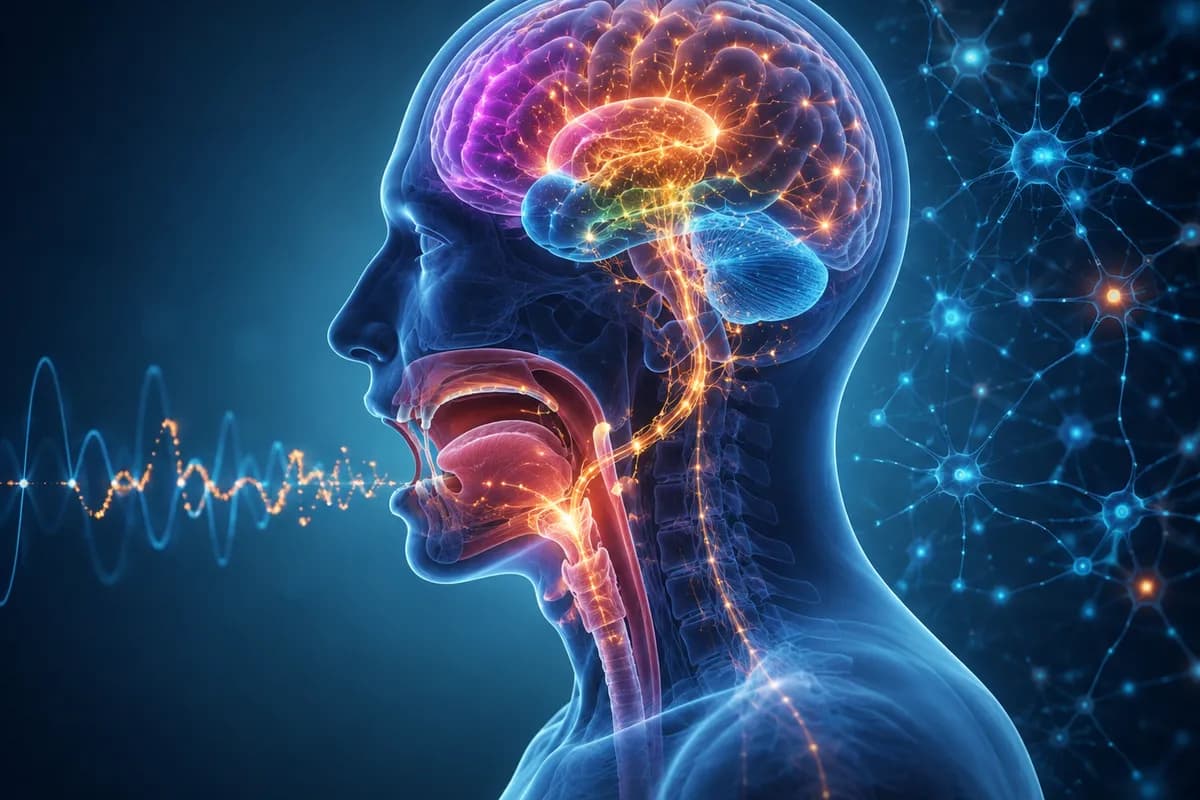
Neurological Causes of Stuttering and the Role of the Brain in Speech Production
Neurological Causes of Stuttering and the Brain’s Role in Speech Production
Stuttering is not limited to the way words are spoken or to the functioning of the speech organs. Findings discussed in the sources used in this file suggest that motor planning, speech timing, language processing, auditory feedback, and the activity of certain brain regions may contribute to the development or persistence of stuttering.
Why Does Speech Production Require Coordination by the Brain?
To produce fluent speech, the brain must perform several processes almost simultaneously:
Selecting the appropriate word
Organizing sentence structure
Planning speech movements
Initiating sound production at the correct time
Coordinating the tongue, lips, jaw, and larynx
Controlling breathing while speaking
Hearing and evaluating the sound being produced
Any disruption in the timing or coordination of these stages can affect speech fluency. Some theories describe stuttering as a disorder involving communication among the language, motor, and auditory systems.
The Role of the Brain’s Hemispheres in Stuttering
In most people, the left hemisphere of the brain plays an important role in language processing and speech planning. According to the material in the file, during typical speech, the frontal regions involved in speech planning are activated first, after which the motor regions carry out speech production.
In people who stutter, this timing pattern may not occur in the usual way, or the sequence in which different brain regions are activated may be altered. Some studies have also reported increased activity in the right hemisphere and reduced normal dominance of the left hemisphere.
However, increased right-hemisphere activity does not necessarily mean that it causes stuttering. The file suggests that right-hemisphere activity may play a compensatory role under certain conditions. In other words, the brain may rely more heavily on regions in the right hemisphere to reduce stuttering symptoms or compensate for impaired functioning in the left hemisphere.
Impairment in the Motor Planning of Speech
One important theory of stuttering proposes that there is a deficit in the motor control of speech. According to this theory, the muscles responsible for speech production are not controlled, timed, or coordinated properly.
Speech is a rapid and highly precise motor skill. The respiratory muscles, larynx, tongue, jaw, and lips must move in an exact sequence within extremely short periods of time. If the timing of these movements is disrupted, sound repetitions, prolongations, or speech blocks may occur.
The file indicates that people who stutter perform more slowly than people who do not stutter in certain speech-motor tasks, or that their performance is more variable. These differences may be observed in breathing, laryngeal muscle activity, and articulatory movements.
Motor Areas of the Brain and Stuttering
Neurological research has identified several parts of the brain that participate in the planning and execution of speech. The file refers to the roles of the following regions and systems:
Broca’s area
The premotor cortex
The supplementary motor area
The motor cortex
The cerebellum
The basal ganglia
The pyramidal and extrapyramidal pathways
Some findings have shown reduced activity in language-processing regions in people who stutter, while regions associated with motor functioning have displayed excessive activity.
This pattern may indicate that the brain makes a greater motor effort to produce speech, while coordination between language processing and the execution of speech movements does not occur optimally.
Differences in the Sequence of Speech Processing
Studies discussed in the file compared the reading-processing pathway in people who do not stutter with that of people who stutter.
In people who do not stutter, reading processing begins in the occipital region and then moves to Broca’s area, the premotor region, and the motor cortex. This sequence suggests that language processing and planning take place first, followed by the execution of movement.
In people who stutter, however, processing may move from the occipital region to the premotor and motor areas first, with Broca’s area becoming active afterward. This difference may reflect poor coordination between linguistic planning and the motor execution of speech.
The Role of the Cerebellum in Speech Fluency
The cerebellum plays a role in coordinating, timing, and correcting movements. According to the material in the file, this part of the brain may have particular importance in the production of fluent speech in people who stutter.
Some studies have reported differences in the activity of the cerebellum and other motor regions between people who stutter and those who do not. These differences may be related to the brain’s attempts to regulate the timing of speech movements or compensate for existing coordination difficulties.
The Role of the Basal Ganglia in Speech Initiation
The basal ganglia are subcortical brain structures involved in regulating motor activity and initiating movement. Because the timely initiation of speech is an important stage in producing words, impaired functioning in these regions may influence stuttering.
The file indicates that the basal ganglia display abnormal patterns of activity during stuttered speech. Pathological, genetic, and developmental evidence has also been proposed to support the possible involvement of these structures.
This may help explain why some people who stutter experience speech blocks when beginning a word or sentence.
The Role of White Matter in the Brain
The brain’s white matter consists of nerve fibers that connect different regions. Proper communication among language, sensory, and motor regions is essential for fluent speech production.
According to the file, reduced white-matter integrity has been reported in certain brain regions in people who stutter. Disruption in these pathways may delay the transmission of information among speech planning, sensory feedback, and movement execution.
Another study also found reduced white-matter integrity beneath underactive areas of the ventral premotor cortex. These pathways connect the motor cortex with temporal and parietal regions and contribute to integrating speech planning with sensory feedback.
Dopamine and Other Neurotransmitters
Another theory concerning stuttering focuses on the role of neurotransmitters. The file refers to the possibility of excessive activity in the dopamine system.
According to this view, increased dopamine activity may contribute to the production of certain stuttering symptoms. For this reason, some medications that have been studied for the management of stuttering have been dopamine-blocking drugs or dopamine antagonists.
The possible involvement of the serotonin system has also been proposed, but the material in the file does not provide a definitive conclusion about its role. Dopamine and serotonin should therefore be regarded as possible factors that remain under investigation, rather than as proven causes of stuttering.
The Relationship Between Language Processing and Stuttering
Stuttering is not solely a motor disorder, because the linguistic characteristics of a sentence can also influence its severity. According to the material in the file, greater syntactic complexity may be associated with increased disfluency.
The typical age at which stuttering begins in children also coincides with a period of rapid language development. This overlap has led some researchers to investigate language processing and its coordination with the speech-motor system.
When a child wants to produce a long or complex sentence, the brain must quickly organize vocabulary, grammar, and speech movements. When these processes are not adequately coordinated, disfluency may become more likely.
The Delayed Brain Maturation Theory
One theory discussed in the file concerns delayed maturation of certain neurological systems. A study involving children who stutter reported a greater presence of slow brain waves than in children who did not stutter. This finding was attributed to delayed maturation of the nervous system.
According to this theory, the language-processing and speech-motor control systems in the left hemisphere may develop more slowly. Delayed development of these systems could create poor coordination between language processing and the execution of speech movements.
The file also suggests that spontaneous recovery from stuttering in many children may be associated with the gradual maturation of the brain and improved coordination between the language and motor systems.
Nevertheless, delayed brain maturation is only one possible explanation and is not presented in the text as a definite cause of every case of stuttering.
The Role of Auditory Processing
While speaking, a person hears their own voice and uses it to regulate speech production. This process is known as “auditory feedback.”
Some studies have reported auditory-processing difficulties in people who stutter. These difficulties may involve only the reception and analysis of sound, or they may involve a combination of auditory processing and speech-motor control.
However, the file notes that there is no clear evidence of structural abnormalities in the hearing system of people who stutter. The results of electrophysiological studies have also been inconsistent. There is greater agreement regarding the possibility of impaired central processing of auditory information, rather than simple damage to the ear or peripheral auditory system.
Why Does Altering Auditory Feedback Reduce Stuttering?
Delayed auditory feedback has been used for many years to reduce stuttering temporarily. With this method, individuals hear their own voices after a short delay. Changing the frequency of the voice or masking the speaker’s voice may also reduce disfluency in some situations.
The reduction of stuttering when the way a person hears their voice is altered suggests that coordination between auditory processing and the motor planning of speech may be involved in the disorder. However, the effects of these methods may be temporary, and a reduction in symptoms does not necessarily mean that the underlying cause of stuttering has been treated.
The Relationship Among Motor, Linguistic, and Auditory Factors
Although stuttering is most commonly observed as repetitions, prolongations, and speech blocks, it cannot be attributed solely to the motor system.
Sentence complexity and utterance length may increase stuttering, while altered auditory feedback may reduce it. These findings suggest that motor, linguistic, auditory, and sensory systems work together in the production of fluent speech.
Neuroimaging studies have also identified differences in motor, premotor, and auditory regions, as well as in the cerebellum, midbrain, and white matter. According to the conclusion presented in the file, stuttering may be associated with disturbances in cortical and subcortical neural systems responsible for selecting, initiating, and executing sequences of speech movements.
Can a Single Brain Region Be Considered the Cause of Stuttering?
The material in the file describes the involvement of several regions in stuttering, including the frontal cortex, motor regions, cerebellum, basal ganglia, auditory areas, and white-matter pathways.
Therefore, based on this source, it is not possible to conclude that a single brain region causes stuttering. The overall picture instead suggests a disturbance in a widespread network that coordinates linguistic, motor, auditory, and speech-timing functions.
Some brain differences may contribute to the development of stuttering, while others may result from the brain’s attempts to compensate for disfluency. The file does not provide a definitive distinction among all these possibilities.
Conclusion
Findings concerning stuttering suggest that the disorder may be associated with poor coordination among language processing, motor planning, speech execution, and auditory feedback.
Differences in the activity of the brain’s hemispheres, impaired timing of speech movements, the involvement of the cerebellum and basal ganglia, reduced integrity of certain white-matter pathways, and the possibility of delayed nervous-system maturation are among the explanations proposed for stuttering.
However, no single and definitive cause has yet been identified for all types of stuttering. Based on the material in this file, it is more appropriate to view stuttering as a multifactorial disorder involving a widespread network of neurological, motor, linguistic, and auditory systems.

please Login to leave a comment
Add Your Comment
Reviews